WCE Subsea Trainer
Shaun Smithers
Hands-on BOP and well-control-equipment training, rig-inspection workshops, course development and crew-skills assessment.

TRAINING & LOCAL CAPABILITY
KAGES supports long-term local capability through individual development, practical mentoring and competency reviews, alongside VR behavioural and cultural learning and specialist subsea, offshore and MPD training.
THE KAGES APPROACH
KAGES builds individual development plans around each participant's role, experience and host-organisation priorities. Specialist mentoring and supervised project work provide practical evidence for regular review.
Agree the starting point, responsibilities and individual development priorities.
Build experience through supervised assignments and specialist mentoring.
Use recorded progress and mentor feedback to agree the next development steps.

Professional communication
KAGES offers English language training alongside its NOC and ministry mentoring programmes. Programmes can combine direct, in-person teaching and online learning, with content shaped around each organisation's professional requirements.
Bespoke learning for professional communication and negotiations, with programmes relevant to foreign diplomats, government employees and oil and gas workers.
Learning objectives can be developed around Cambridge-level expectations and agreed starting levels. Course design and delivery arrangements are agreed for each engagement.
Employee programmes use an agreed assessment, cohort and progression structure. Larger workforce requirements can be scoped around participant numbers, locations, delivery format and available teaching resources.
Brent Quigley’s professional experience includes online general and business English, bespoke professional syllabuses, negotiation preparation for civil servants and teacher-development seminars for groups of up to 60 teachers.
Safe practices and multicultural teams
Behavioural Safety & Cultural Training with Marc Allert and Mark Cussons helps people put safer working practices into everyday use and collaborate effectively in multicultural working environments.
Different languages, cultural expectations and ways of communicating can affect how teams recognise hazards, raise concerns and work together. Training focuses on shared understanding, trust and personal accountability so people can challenge at-risk behaviours and support one another.
Marc combines psychology, human factors and VR learning with practical behavioural coaching. Mark brings behavioural and cultural coaching, workplace observations and training development. Together, these disciplines support shared responsibility and clear communication between managers, supervisors and site teams.
Connected Specialist System
VBS connects this training with the HUB 2 Completions System. Once the critical path and the systems and sub-systems being readied for work are known, behavioural and cultural SMEs gather real-time worksite information and prepare VR learning around the actual dangers.
Construction and commissioning crews receive the system-specific briefing before they begin work, helping multicultural teams recognise hazards and agree a shared approach to working safely.
Practical Offshore Expertise
Practical technical training connects equipment knowledge, inspections and operational readiness with the skills required by offshore crews. Programmes are shaped around the equipment, roles and learning requirements.
WCE Subsea Trainer
Hands-on BOP and well-control-equipment training, rig-inspection workshops, course development and crew-skills assessment.
Offshore Technical Manager Trainer
Marine, electrical, mechanical and subsea training, connecting practical courses, technical audits and crew mentoring.
The five-year approach provides direction for individual development, with annual reviews of progress, support needs and suitable responsibilities. The framework adapts to demonstrated competence rather than guaranteeing promotion or accreditation.
Agree the role, assess the starting point and build an individual development plan.
Combine structured learning with supervised, practical experience on the project.
Increase responsibility as demonstrated competence develops, with mentoring and review.
Strengthen technical judgement, coordination and the ability to support others.
Review progress, consolidate skills and plan the next stage with the host organisation.
DEVELOPMENT IN PRACTICE
Explore an anonymised development-plan example showing role-based planning, departmental assignments and competency assessment. Two worksheet views and two charts distinguish current assessment from planned growth.
Reviews compare agreed expectations, current self-assessment and planned development with evidence from practical work and mentor feedback. Future-year projections are plans, not achieved results.
An anonymised example showing how a participant's role, mentor, departmental assignments and development priorities can be recorded.
One view of the shared development-plan example; participant identifiers have been anonymised.
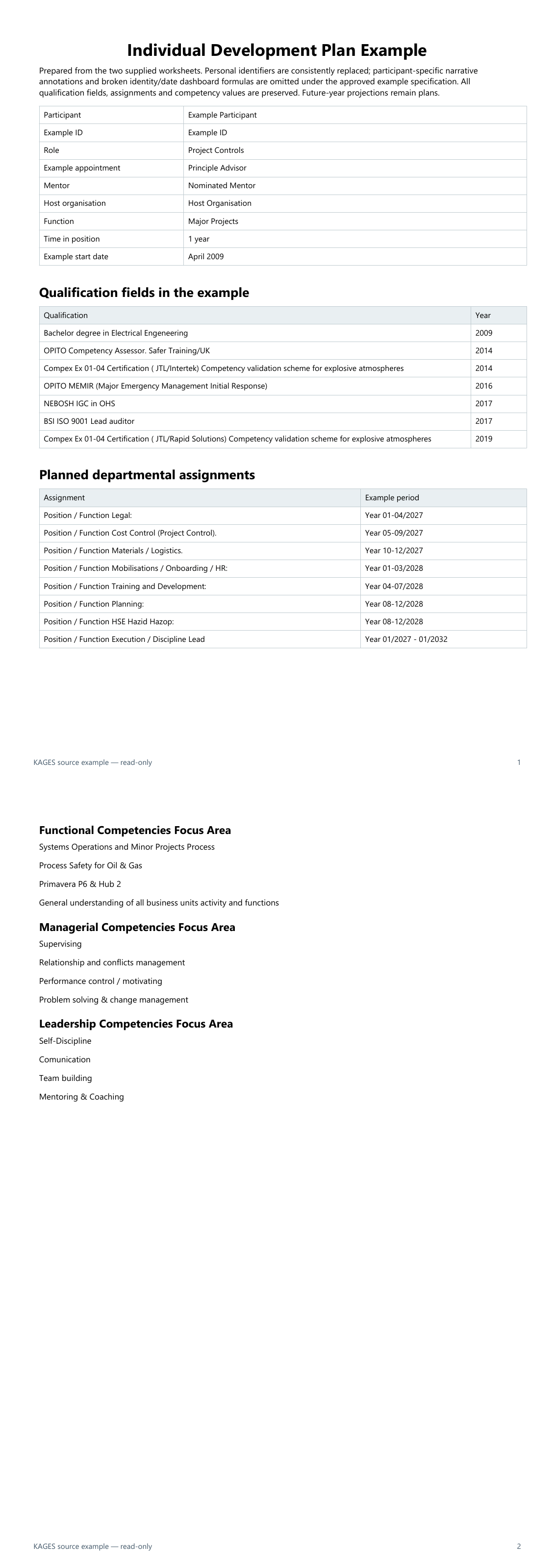 Enlarge Individual Development Plan source-data view with anonymised example identifiers
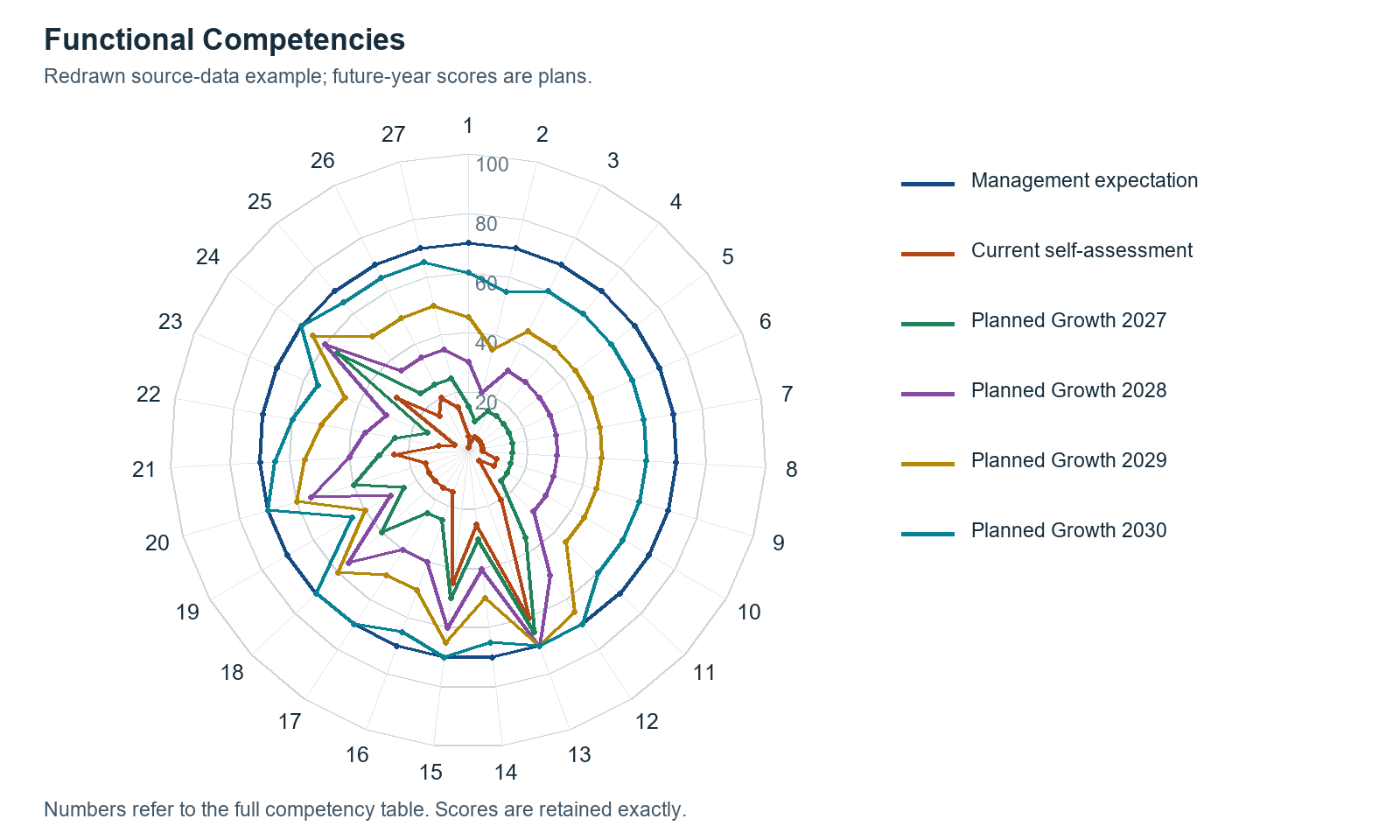
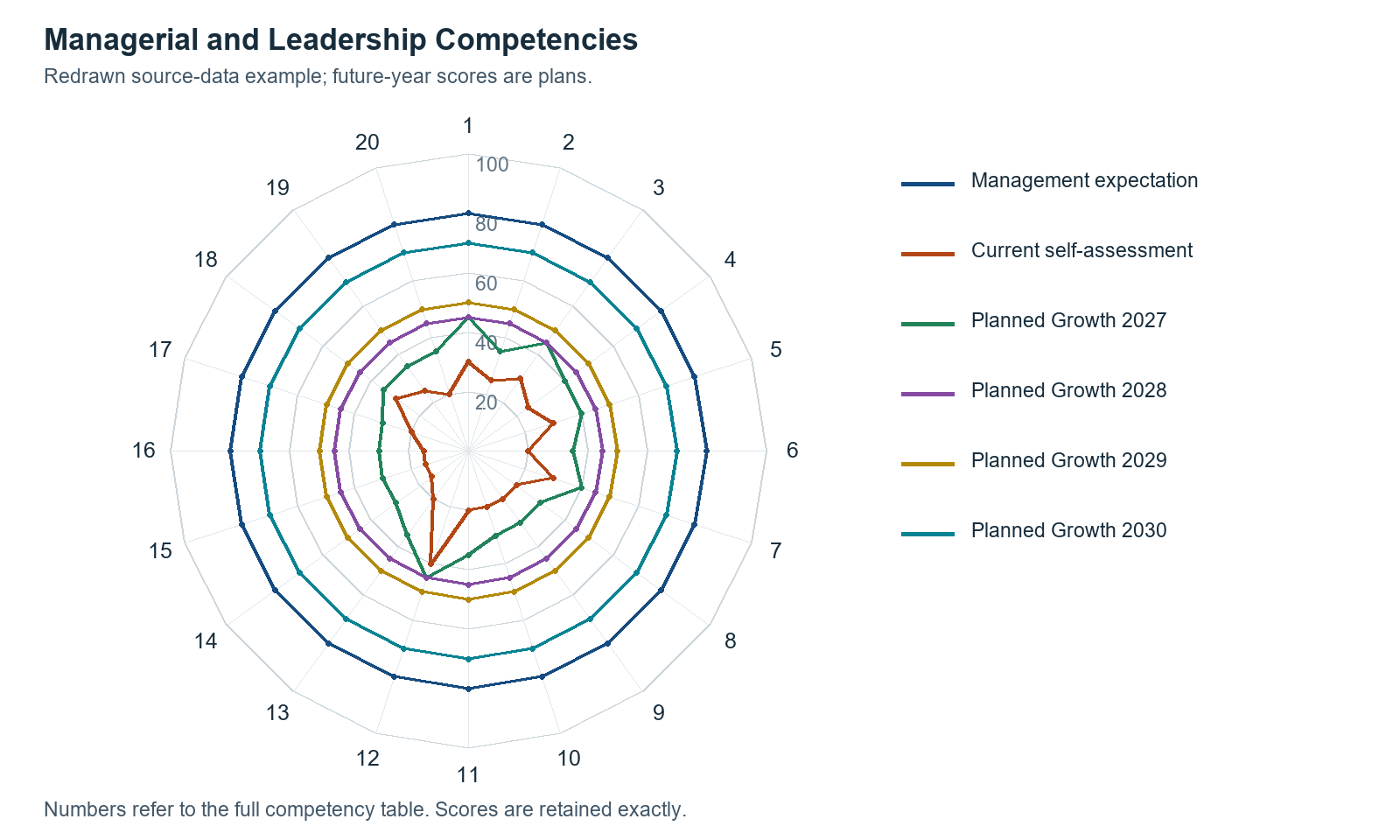
Compare management expectations, current self-assessment and planned competency development across functional and leadership disciplines.
These are example scores and projections from the same development-plan example, not achieved competence.
 Enlarge Competency Assessment and Development source-data view with anonymised example identifiers
Illustrative Development Plan: Example. Identifiers are replaced consistently with Example Participant, Example ID, Nominated Mentor and Host Organisation. Participant-specific narrative annotations are omitted from this review example.
These are fields in an anonymised example, with the source notation retained.
| Assignment | Example period |
|---|---|
| Position / Function Legal: | Year 01-04/2027 |
| Position / Function Cost Control (Project Control). | Year 05-09/2027 |
| Position / Function Materials / Logistics. | Year 10-12/2027 |
| Position / Function Mobilisations / Onboarding / HR: | Year 01-03/2028 |
| Position / Function Training and Development: | Year 04-07/2028 |
| Position / Function Planning: | Year 08-12/2028 |
| Position / Function HSE Hazid Hazop: | Year 08-12/2028 |
| Position / Function Execution / Discipline Lead | Year 01/2027 - 01/2032 |
The charts illustrate management expectations, current assessment and four years of planned development. Numerical scores remain available in the accompanying tables.
Numbered keys match the complete competency names and scores in the tables below. Enlarge the chart for closer inspection.
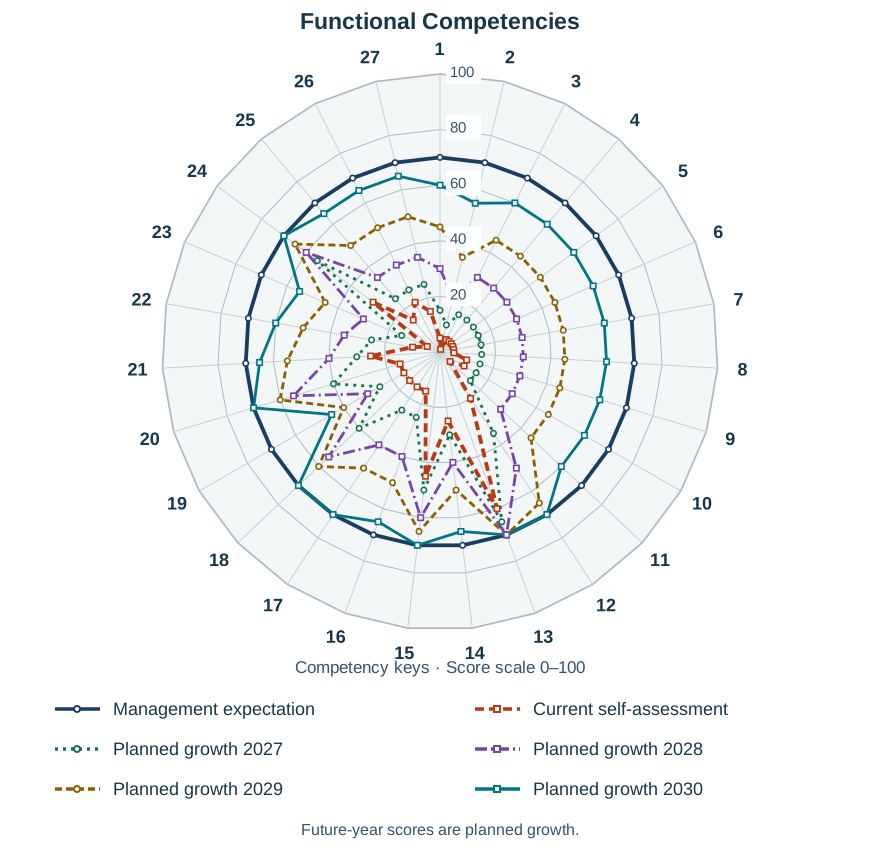
The chart compares management expectation, current self-assessment and the four planned-growth series for 2027, 2028, 2029 and 2030. Its numeric category keys match the full competency labels and unchanged scores in the adjacent data table.
Numbered keys match the complete competency names and scores in the tables below. Enlarge the chart for closer inspection.
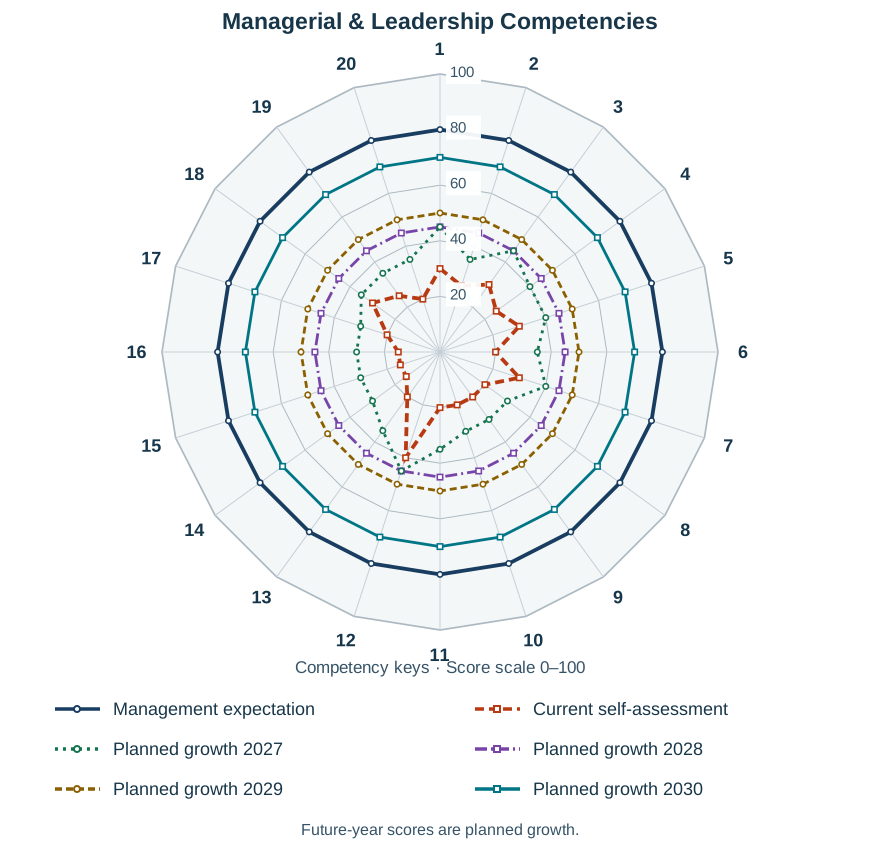
The chart compares the same six source series for the 20 managerial and leadership competencies. Category keys match the full labels and scores in the adjacent data table.
| Key | Competency | Expectation Level / From Management | Current Self Assess Status | Planned Growth 2027 | Planned Growth 2028 | Planned Growth 2029 | Planned Growth 2030 |
|---|---|---|---|---|---|---|---|
| 1 | Legal: (Insert Country) | 70 | 5 | 15 | 30 | 45 | 60 |
| 2 | Legal: International / Best Practise | 70 | 1 | 10 | 20 | 35 | 55 |
| 3 | Legal: Industrial Relationships | 70 | 5 | 15 | 30 | 45 | 60 |
| 4 | Legal: Regulatory Affairs | 70 | 5 | 15 | 30 | 45 | 60 |
| 5 | Cost Control (Project Control): Resource | 70 | 5 | 15 | 30 | 45 | 60 |
| 6 | Cost Control (Project Control): Estimating | 70 | 5 | 15 | 30 | 45 | 60 |
| 7 | Cost Control (Project Control): Budgeting | 70 | 5 | 15 | 30 | 45 | 60 |
| 8 | Cost Control (Project Control): Cost Control | 70 | 5 | 15 | 30 | 45 | 60 |
| 9 | Materials Management / Procurement | 70 | 10 | 15 | 30 | 45 | 60 |
| 10 | Materials Management / Logistics | 70 | 10 | 15 | 30 | 45 | 60 |
| 11 | Materials Handling | 70 | 5 | 15 | 30 | 45 | 60 |
| 12 | HR/Compensation & Benefits | 70 | 20 | 35 | 50 | 65 | 70 |
| 13 | HR/Training and Development | 70 | 60 | 65 | 70 | 70 | 70 |
| 14 | HR Compliance | 70 | 25 | 30 | 40 | 50 | 65 |
| 15 | HR/Onboarding | 70 | 45 | 50 | 60 | 65 | 70 |
| 16 | Planning / P6 Scope Planning / Goals | 70 | 15 | 25 | 40 | 50 | 65 |
| 17 | Planning / P6 Constrains Management | 70 | 15 | 25 | 40 | 50 | 70 |
| 18 | Planning / P6 Resourses & Procurement Planning | 70 | 15 | 40 | 55 | 60 | 70 |
| 19 | Planning / P6 Schedules Development | 70 | 15 | 25 | 30 | 40 | 45 |
| 20 | Planning / P6 Execution Control & Quality Management | 70 | 15 | 40 | 55 | 60 | 70 |
| 21 | HSE/ HAZID | 70 | 25 | 30 | 40 | 55 | 65 |
| 22 | HSE/ HAZOP | 70 | 10 | 25 | 35 | 50 | 60 |
| 23 | HSE/ Process Safety | 70 | 5 | 15 | 30 | 45 | 55 |
| 24 | Disciplines/ Electrical / EX | 70 | 30 | 55 | 60 | 65 | 70 |
| 25 | Disciplines/ Instruments | 70 | 15 | 25 | 35 | 50 | 65 |
| 26 | Disciplines/ Mechanical | 70 | 20 | 25 | 35 | 50 | 65 |
| 27 | Disciplines / HVAC | 70 | 15 | 25 | 35 | 50 | 65 |
| Key | Competency | Expectation Level / From Management | Current self Assess Status | Planned Growth 2027 | Planned Growth 2028 | Planned Growth 2029 | Planned Growth 2030 |
|---|---|---|---|---|---|---|---|
| 1 | Motivating Others | 80 | 30 | 45 | 45 | 50 | 70 |
| 2 | Communication Skills | 80 | 25 | 35 | 45 | 50 | 70 |
| 3 | Conflict Resolution | 80 | 30 | 45 | 45 | 50 | 70 |
| 4 | Problem Solving | 80 | 25 | 40 | 45 | 50 | 70 |
| 5 | Developing others /Team Building / Coaching | 80 | 30 | 40 | 45 | 50 | 70 |
| 6 | Vision/Planning | 80 | 20 | 35 | 45 | 50 | 70 |
| 7 | Emotional Intelligence | 80 | 30 | 40 | 45 | 50 | 70 |
| 8 | Manage Performance | 80 | 20 | 30 | 45 | 50 | 70 |
| 9 | Delegation | 80 | 20 | 30 | 45 | 50 | 70 |
| 10 | Interviewing Skills | 80 | 20 | 30 | 45 | 50 | 70 |
| 11 | Goal-Setting & Achieve | 80 | 20 | 35 | 45 | 50 | 70 |
| 12 | Relationship Building | 80 | 40 | 45 | 45 | 50 | 70 |
| 13 | Agility & Adaptability | 80 | 20 | 35 | 45 | 50 | 70 |
| 14 | Dependability | 80 | 15 | 30 | 45 | 50 | 70 |
| 15 | Integrity | 80 | 15 | 30 | 45 | 50 | 70 |
| 16 | Decisiveness | 80 | 15 | 30 | 45 | 50 | 70 |
| 17 | Innovation & Creativity | 80 | 20 | 30 | 45 | 50 | 70 |
| 18 | Employee Motivation | 80 | 30 | 35 | 45 | 50 | 70 |
| 19 | Decision-Making | 80 | 25 | 35 | 45 | 50 | 70 |
| 20 | Negotiation | 80 | 20 | 35 | 45 | 50 | 70 |
KAGES' bespoke MPD project implementation training supports client teams planning or implementing an MPD system. It connects project definition, equipment requirements, commercial responsibilities, vessel integration and installation planning.
The course covers concept through implementation, functional design specifications, commercial and supply/service contracts, execution and control planning, equipment requirements and shipyard installation.
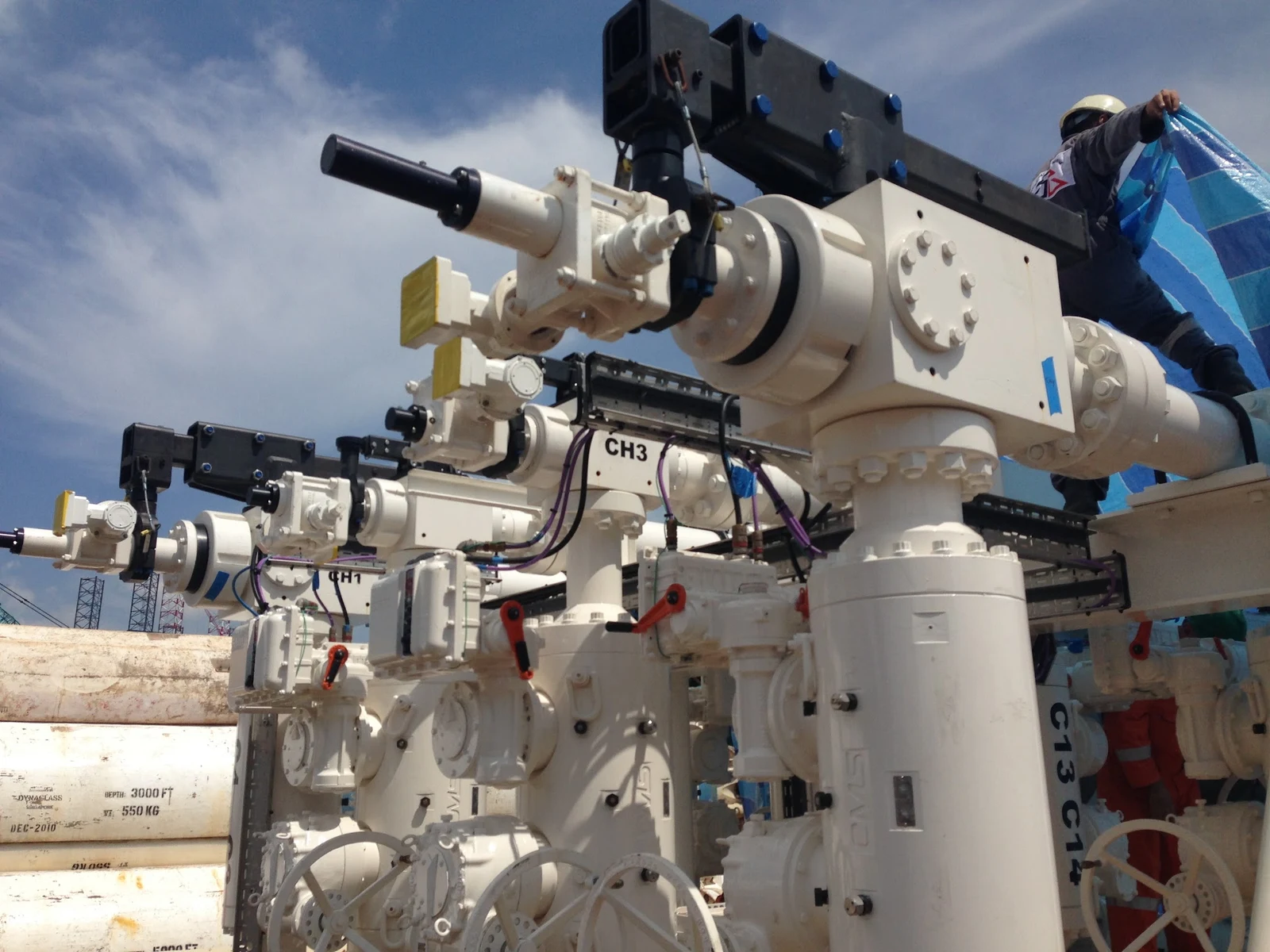 Enlarge White MPD choke manifold with labelled valves, actuators and flanged pipework.
A six-choke manifold designed specifically for the managed pressure drilling (MPD) installation. The close-up shows the arrangement of the choke valves, actuators and connected pressure-control pipework, including the labelled CH1 and CH3 positions.
View the anonymised development-plan example and the MPD project-training presentation directly, or download PDF copies for discussion.
One anonymised example containing the individual development-plan and competency-assessment views.
Training material covering the project considerations behind bespoke MPD system implementation.